
It looks like this account violates Google Workspace policies. It may be used for sending spam or committing fraud.
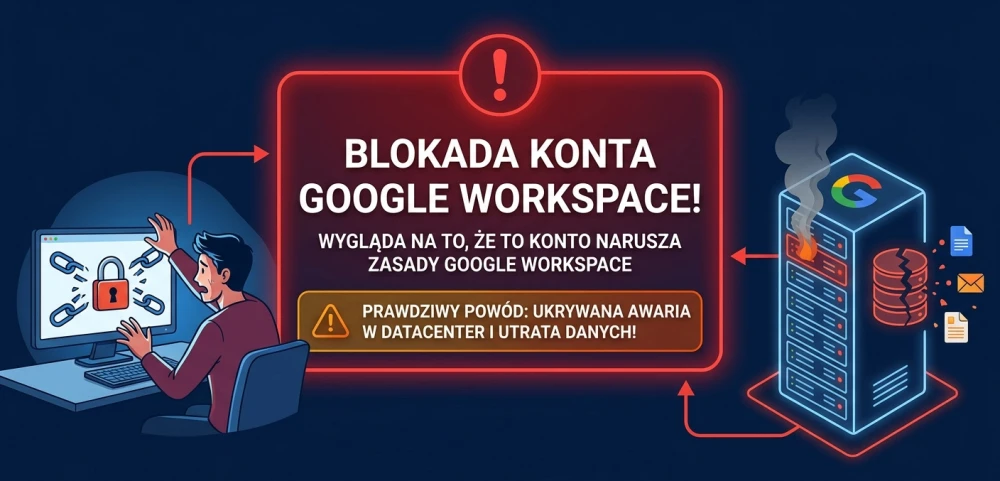
Google Workspace users worldwide are facing a sudden wave of account blocks that began on March 2, 2026. Official messages displayed upon login attempts suggest that accounts violate service policies, potentially being used for spam or fraud. However, a deeper analysis of the problem points to an entirely different, much more disturbing cause.
Official Statement vs. Reality
Blocked users see a standard warning: "It looks like this account violates Google Workspace policies". This phrasing places customers in the role of culprits, suggesting a breach of terms. Meanwhile, the widespread nature of this phenomenon coincided with unofficial reports of a serious outage in Google's key data centers. Everything indicates that the blocks are not a result of user actions, but an attempt to mask critical data loss.
Concealed Datacenter Outage
According to gathered information, a widespread disk array failure occurred in one of the main cloud infrastructure clusters on the night of March 1-2. The consequence of this event is the permanent loss of access to thousands of mailboxes, documents, and files stored in the Workspace service.
Instead of transparently informing about the technical incident, the system mechanism automatically flags these "empty" or corrupted profiles as violating policies. This mechanism cuts off the user from the interface, preventing them from verifying what actually remains in their account.
Strategy for Avoiding Compensation
Why does Google opt for a narrative of "policy violation" instead of admitting to an outage? The answer lies in SLA (Service Level Agreement) contracts. Admitting to massive data loss and downtime due to provider fault would obligate the giant to:
- Paying huge compensation for the unavailability of business services.
- Covering losses resulting from the irreversible loss of clients' intellectual property.
- Initiating costly legal procedures in thousands of jurisdictions.
By shifting the blame to alleged "policy violations" or "spam," the burden of proof is transferred to the customer. This is a calculated strategy aimed at protecting the corporation's finances at the expense of the trust and data security of businesses using trmail.xyz and other domains integrated with the Google ecosystem.
What Does This Mean for Users?
If your account was blocked on March 2, 2026, there is a high probability that your data fell victim to this very outage. The inability to log in is not just a lack of access to current mail; it's primarily a lack of insight into whether backups of your files still exist in the Google cloud at all. In the face of the giant's silence, the only path forward remains independent verification and securing alternative communication channels.